Fan: Auto, On, or Circulate?
The free setting most homeowners do not know about.
Short answer: For most homes, leave the fan on AUTO it's the cheapest, and in summer it's the only setting that actually lets your system pull humidity out of the home. ON runs the blower 24/7 for even temperatures and constant filtering, but it costs more and can leave your home feeling clammy. CIRCULATE (Circ) is the middle ground a lot of people don't know they have: the fan runs part of every hour to keep air moving and filtered, without the full penalty of ON. It costs you nothing to change so, it's worth understanding what each one really does.
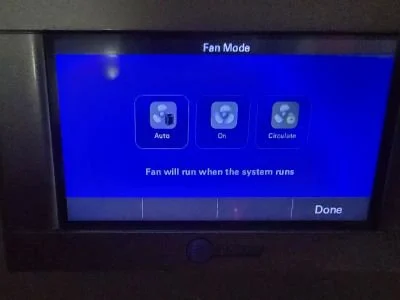
A smart thermostat showing the Auto, Circulate and On selections
What each setting actually does
AUTO, the blower only runs when the system is actively heating or cooling. Call for cool, the compressor and fan come on together; hit your temperature, both shut off. Simple.
• Cheapest to run the fan only when there's a reason to.
• The right default for most homes
• Best for humidity and this is the big one. When your AC runs, moisture condenses on the cold coil (that's dehumidifying). On AUTO, the fan shuts off with the compressor, so that water has time to drip down and drain away outside. That's how your home gets that dry, cool, comfortable feel.
• Easier on the equipment less runtime means less wear on the blower motor.
• The trade-off: between cycles the air sits still, so temperatures can drift a little from room to room, and the air can feel stagnant.
ON even air, but with a catch
ON, the blower runs continuously, 24 hours a day, whether the system is heating or cooling.
• Even temperatures. Room to room, because the air never stops moving.
• Constant filtration. All your air keeps passing through the filter, which people with allergies often like (pair it with a good filter for it to mean something).
• The catch that surprises people humidity. In cooling season, the moment the compressor shuts off but the fan keeps running, all that water still sitting on the cold coil gets blown right back into your home as humidity before it can drain. Your AC just spent energy pulling moisture out, and the fan hands it straight back. The home ends up feeling cool but clammy.
• Higher power bill and more wear. You're running a motor around the clock, and the filter loads up faster, requiring to be changed more frequently.
• Heat pump owners, take note. In heating, a heat pump's air comes out warm but cooler than a gas furnace below your body temperature. ON, between heating cycles the fan keeps pushing that cooler air, and it feels like a cold draft. A lot of heat pump owners run the fan on ON and then wonder why the home feels chilly that's exactly why. In heating season, AUTO or Circ keeps a heat pump feeling warmer.
CIRCULATE (Circ) the middle ground you may not know you have
This is the one worth knowing about. CIRCULATE, the thermostat runs the fan a set portion of every hour typically around 20 to 35 minutes even when the system isn't heating or cooling. Many programmable and smart thermostats have it; a lot of people just never scroll to it.
• Keeps air moving and filtered. More often than AUTO, so you don't get the stagnant, uneven feel.
• Far less energy and humidity penalty than ON. The fan gets its breaks, so the coil still has time to drain between runs.
• Adjustable on many thermostats. You can dial the percentage up or down to taste.
• Best of both worlds for a lot of homes, especially with a modern variable-speed blower (more on that next).
One thing that changes the whole answer to your blower motor
Here's what most articles leave out. How much ON or CIRCULATE costs you depends heavily on what kind of blower motor you have:
• Older single-speed motors (PSC) run at full power whenever they're on there's no "low." On these, running the fan constantly genuinely adds up on your bill.
• Modern variable-speed motors (ECM) can run along at a low speed that sips power. On a system with one of these, CIRCULATE (or even ON) costs far less to run, and the case for keeping air moving gets a lot stronger.
So if you've got a newer high-efficiency system, don't be afraid of CIRCULATE it's cheap on those. If you've got an older unit, lean toward AUTO and save the runtime.
Quick comparison
| Setting | Comfort / even temps | Humidity in summer | Energy cost | Best for |
|---|---|---|---|---|
| AUTO | Can drift between cycles | Best — coil drains properly | Lowest | Most homes, humid climates, older systems |
| ON | Most even, constant filtering | Worst — re-humidifies the home | Highest | Dry climates, allergy needs with strong filtration, variable-speed systems |
| CIRCULATE (Circ) | Good, regular air movement | Middle — better than ON | Moderate | A great default compromise, allergy needs, spring & fall, and variable-speed systems |
So what should you pick?
• My rule of thumb, by season: Run AUTO during the peak of cooling and heating season, when the system runs plenty on its own and humidity control matters most. Switch to CIRCULATE (Circ) in spring and fall, when the system barely runs and the air can go stale and needs filtering. Match the fan to how hard the system is already working.
• Live somewhere humid? Use AUTO in cooling season. Humidity control matters more than even air — a dry 76° beats a clammy 74° every time.
• Want more even temperatures or better filtering? Try CIRCULATE before you jump to ON. You get most of the benefit without the humidity and cost hit.
• Have allergies and a good filter? CIRCULATE or ON keeps air passing through it just know ON in summer trades away some humidity control.
• Have an older single-speed system? Stick with AUTO. Running that motor nonstop isn't worth it.
• Have a newer variable-speed system? CIRCULATE is often the sweet spot, cheap to run and comfortable.
The bottom line
There's no single right answer but there is a right answer for your home, and it costs nothing to dial in. Start on AUTO. If the air feels stale or the far bedroom never matches the thermostat, step up to CIRCULATE and see if that fixes it. Only reach for full ON if you've got a specific reason and a system that won't punish you for it.
Whatever you pick, none of it works without a clean filter a fan just moves air through whatever's in the way.
One thing worth knowing as a customer. This is a free setting on a thermostat you already own. If anyone tries to sell you equipment to "even out your air" before you've simply tried CIRCULATE with a good filter, start there first.