Low on refrigerant? Why maybe "topping off" is a rip-off
Refrigerant Doesn't Get "Used Up"! If You're Low, You Have a Leak!
Short answer: Your air conditioner or heat pump is a sealed system. The refrigerant inside is supposed to last the entire life of the unit it doesn't burn off, wears out, or get "used up" like oil in a car. So if a tech tells you it's "low on refrigerant" and just adds more, they've treated the symptom and left the disease. You have a leak. Pay to top it off without finding that leak and you'll be writing the same check next summer and with refrigerant prices climbing, that check gets bigger every year.
One quick note on the word "Freon." "Freon" is actually a brand name a registered trademark (originally DuPont's) not the stuff itself. The correct general term is "refrigerant." Just about everybody, techs included, still says "Freon" out of habit, so I'll use it here and there the way you'll actually hear it but technically your system runs refrigerant, not Freon.
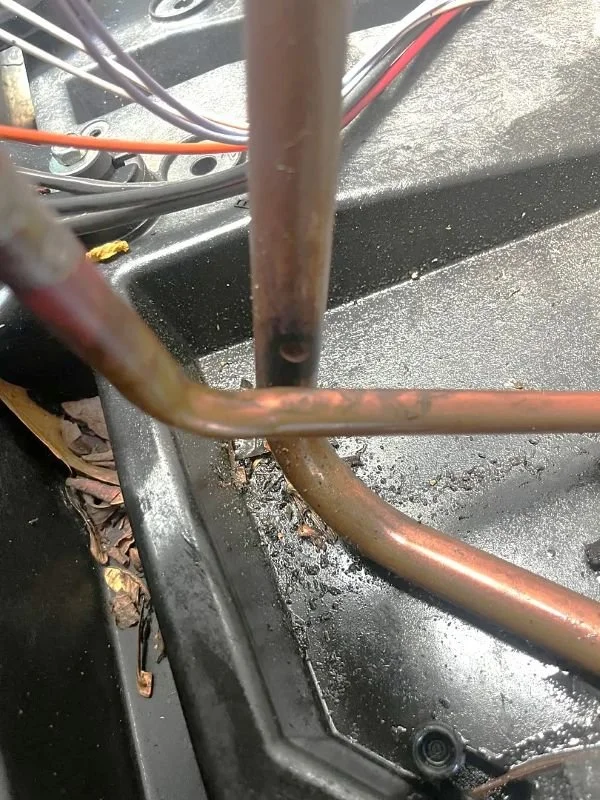
This is where two pipes rubbed together and created a hole in one of the pipes allowing the refrigerant to escape. You can see refrigerant oil on the pan below it
Here's the part the "recharge special" ads never explain. Refrigerant runs in a closed loop, a sealed circuit of copper that carries it from inside to outside and back, repeatedly, pulling heat out of your house. Nothing is consumed. It's not fuel. In a system that's working right, the charge you got the day it was installed is the same charge it'll have the day you replace it, years later.
So there is exactly one reason a system runs low: it's escaping somewhere. A loose fitting, a corroded coil, a rubbed-through line or a bad valve. That's a leak and the only real fix is to find it and seal it.
This goes double for a heat pump. A heat pump is the same sealed refrigerant loop, it just runs in both directions, pulling heat into your house in winter and out of it in summer. So, a leak in a heat pump doesn't just cost you air conditioning; it steals your cheap heat too. If your heat pump won’t heat in January or won't cool in July, the refrigerant conversation is exactly the same.
Signs you're actually low
• Weak, warmish air that never quite cools the house, even running all day.
• Ice on the lines or coil. Low refrigerant drops the pressure, and the coil gets cold enough to freeze the same frozen-up symptom a dirty filter causes, which is why it needs a pro to tell them apart.
• A hissing or bubbling sound near the lines sometimes you can hear a leak.
• Longer and longer run times and a climbing power bill as the system struggles especially in the wintertime.
• Oily residue on the copper lines or at fittings. Refrigerant carries oil, so a greasy spot often marks the leak.
The rip-off, step by step
This is how it usually plays out, and why it costs you:
• The house isn't cooling. A tech comes out, hooks up gauges, says you're low, and adds a couple pounds
• The house cools again. You pay, they leave. Everybody's happy for a while.
• But the leak is still there. That fresh refrigerant is already on its way out the same hole the last charge left through.
• Next summer (or sooner) you're hot again, calling again and paying again.
You're not buying a fix. You're renting cold air by the pound and the most expensive way there is to run an air conditioner or heat pump. Every top-off also vents the old leaking refrigerant into the atmosphere, which is exactly what the federal rules are trying to stop.
When a top-off (or even stop-leak) is a fair call
Now the honest flip side, because it's not always a rip-off. A top-off is only a rip-off when it's sold as the fix. There are legitimate times a good tech will add a little refrigerant or even use a stop-leak product on purpose, to buy you time. If your system is already on its last legs and you've decided to replace it, but you need to get through the rest of a brutal summer (or a cold snap on a heat pump) until the new unit is installed, a stopgap charge to keep you comfortable for a few weeks can be a reasonable, even kind, call.
The difference is honesty and a plan. Good tech tells you plainly: "This won't hold, it's just to get you to the replacement." That's a bridge, not a repair. What makes it a rip-off is the same top-off dressed up as a solution no mention of the leak, no end date so you keep paying for it summer after summer. A stopgap has a replacement plan attached to it. A rip-off doesn't.
Why this matters more than it used to
Refrigerant used to be cheap enough that topping off felt harmless. Not anymore. As of January 2025, the EPA began phasing down R-410A the refrigerant in most systems installed over the last 15 years and prices have jumped 40 to 60 percent. Installed, R-410A now runs roughly $150 to $300 a pound on a service call, so even a modest 2-to-6-pound recharge can land anywhere from several hundred dollars to well over $1,500 before any leak repair. Pay that every summer and you've spent more chasing a leak than it would have cost to fix it several times over.
Got an older R-22 system? My advice is to replace it
If your unit is old enough to run on R-22 — the "Freon" in systems built before about 2010, a leak isn't a repair question anymore. I'll say it plainly: in almost every case, you're better off putting that money toward a new system than pouring it into an old one. Three reasons, and they stack:
• The refrigerant is brutally expensive. R-22 is fully phased out. No one makes it anymore, so what's left is reclaimed and scarce and priced accordingly. A single recharge on an R-22 system can cost more than the last several years of your energy savings combined
• The parts are drying up. Coils, compressors, and matched components for these older units are getting harder to find every year. Even if you fix the leak today, the next failure may leave you hunting for a part that's no longer made and waiting on it in the middle of summer.
• It's costing you every month in energy. This is the one people forget. Most R-22 systems are low-efficiency by today's standards a new system can use dramatically less power to cool the same house. So an old R-22 unit isn't just expensive to repair; it's quietly overcharging you on every power bill it runs. If you own a R-22 heat pump there efficient drops off after 35 degrees requiring more auxiliary heat which if electric is using the more expensive heat strips.
Put those together and the math almost always favors replacement. You're not just avoiding one pricey recharge, you're stepping off a treadmill of expensive refrigerant, scarce parts, and high energy bills all at once. If a contractor wants to sink real money into an R-22 system with a leak, that's your cue to get a replacement quote alongside the repair estimate and compare the two honestly.
Know your refrigerant: the four you'll hear about
Whether you've got an AC or a heat pump, it runs one of these four. Knowing which one tells you a lot about what a leak will cost you and where your system stands:
| Refrigerant | GWP (climate impact) | Flammability | Where it stands |
|---|---|---|---|
| R-22 (“Freon”) | ~1,810 | A1 (non-flammable) | Systems built before ~2010. Production banned since 2020. A leak means replace. |
| R-410A (“Puron”) | ~2,088 | A1 (non-flammable) | Most systems from ~2010–2024. Banned in new equipment since Jan 2025; existing units still serviceable, but refrigerant is getting pricey. |
| R-32 | 675 | A2L (mildly flammable) | Common in mini-splits and many heat pumps (Daikin, Mitsubishi). Current — but already considered transitional. |
| R-454B (“Puron Advance”) | 466 | A2L (mildly flammable) | The default in most new U.S. ducted AC and heat pumps. Current — also transitional. |
The default in most new U.S. ducted AC and heat pumps. Current — also transitional.
Look at the direction of travel in that GWP column each generation is a big step down in climate impact and that's exactly what the regulations are chasing. R-22 is already gone. R-410A got shut off for new equipment in 2025.
Don't assume today's refrigerant is forever, either
Here's something worth knowing before you sink big money into any system: R-32 and R-454B are themselves considered transitional. They're what manufacturers switched to for now, but the same rules that killed R-410A keep tightening. Europe's F-gas regulation is already moving toward a much lower GWP limit for many new systems around 2030, and the U.S. HFC phase-down keeps stepping down through 2036. R-32, at a GWP of 675, sits close enough to those coming limits that few in the industry expect it to be the long-term answer the next generation of ultra-low-GWP refrigerants is already in development.
What that means for you as a homeowner: it's not a reason to wait to replace a dying system — today's R-454B and R-32 units are efficient and will be serviceable for many years. But it is a reason to weigh how long you plan to keep a home, and to be a little skeptical of anyone pushing a premium "future-proof" refrigerant story. In this industry, "future-proof" has a short shelf life.
What to make your tech do instead
A proper job isn't just adding gas. Insist on this:
• Find the leak. A real diagnosis uses an electronic leak detector, bubble soap, UV dye, or a nitrogen pressure test not just gauges and a guess. Leak detection typically runs $100 to $330.
• Repair it. Seal the fitting, fix or replace the leaking coil or line. This is the part that actually solves the problem.
• Then evacuate and recharge to spec. Only after the repair should they vacuum the system down and put in the exact charge the manufacturer calls for by weight or by manufacturer specs, not by "feel."
Beware "stop leak" additives with one exception. If someone offers to pour a can of sealant into your system instead of finding the leak on a unit you plan to keep, be careful. These additives can gum up valves, driers, and the compressor, and many shops won't touch a system that's had it added it's a band-aid that can turn a repair into a replacement. The one time it's defensible is as a deliberate stopgap on a system you've already decided to replace, just to squeeze out the last few weeks. Never on a unit you intend to hang onto.
The math, plainly
• Topping off every summer: several hundred to $1,500+ each time, forever, and rising with refrigerant prices, not counting wear and tear on the compressor.
• Finding and fixing the leak once: leak detection ($100–$330) plus the repair (commonly $150–$600, more for a coils) plus the recharge. Higher upfront cost but should be done.
One real fix beats a decade of top-offs, and it stops you from pouring expensive refrigerant into the sky.
When to call a pro (and what to say)
Refrigerant is sealed, federally regulated, and not a DIY top-off, you legally need certification to buy and handle most of it, and the new A2L refrigerants (R-32, R-454B) in today's systems are mildly flammable and need trained hands. So, this is a pro job but you can be the informed customer who doesn't get milked.
When you call, say it straight: "If it's low, I want the leak found and repaired not just a top-off." Ask them to show you where it's leaking and to put the repair in writing. If a tech adds refrigerant and heads for the truck without a word about the leak, you've found a tech who's treating your wallet as the repair plan. Get a second opinion.
One last thing, just for a more money savings:
The air conditioning in your car works on the exact same principle, a sealed loop of refrigerant. So the next time the quick-lube counter offers to "recharge your car's AC," you already know the punchline. If it needs a recharge, it's got a leak. Same racket, smaller vehicle. The physics doesn't care whether it's attached to your home or parked in your driveway.