High tech or low tech, which thermostat is better?
An Honest Look at Smart, Programmable and Plain-Dial Thermostats
Short answer: For most homes, a smart thermostat is the best pick — not because of the flashy app, but because it adjusts itself when you forget to. A basic programmable is only as good as your willingness to program it, and studies show most people never do. And a plain manual dial still has its place for the right household. The catch nobody mentions at the store: before you buy anything "smart," you need to know whether you have a C-wire behind your current thermostat. Let's sort it out.
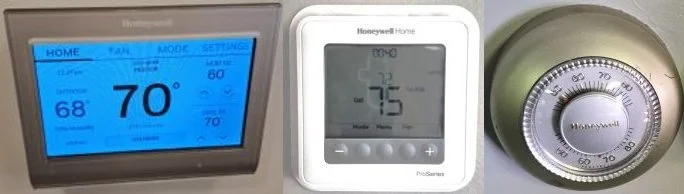
A smart thermostat by a programmable/basic digital thermostat and an old dial thermostat
The three kinds, plainly
• Manual (the dial or basic digital). You set the temperature, it holds it until you change it. No schedule, no app. Dead simple and cheap.
• Programmable. You build a schedule cooler at night, warmer when you're at work and it follows it until you override it. The savings are real if you set them up and leave them alone.
• Smart. Connect to your Wi-Fi and your phone. It learns your patterns and senses when you're home, adjusts for the weather, and shows you where your energy's going. The good ones do the thinking, so you don't have to.
What the savings are
Here's where I'll save you from marketing. The boxes love to promise 20-plus percent savings. The real-world field data tells a calmer story. An ENERGY STAR certified smart thermostat saves about 8% on heating and cooling roughly $50 to $100 a year for a typical home. Nice, but not the jackpot the ads imply.
Here's the honest part most sites won't tell you, the savings don't come from the gadget being smart. They come from not heating and cooling an empty house. A programmable thermostat someone actually uses saves about the same as a smart one. The reason smart thermostats win in the real world is simple they generally give you the app on your phone and some other bells and whistles. Tech isn't magic; it just removes the human step people skip.
Why programmable falls short (it's not the device)
Programmable thermostats work great on paper. The problem is us. Study after study found that somewhere between half and three-quarters of people either never program them or override the schedule so often it makes no difference. ENERGY STAR actually stopped certifying old-style programmable years ago for exactly that reason the savings only show up if the thing gets used as intended, and it usually doesn't.
So, if you're the type who'll set a schedule once and leave it, a programmable is a fine, cheap choice. If you know you'll fiddle with it, a smart one that adjusts on its own is money better spent.
Remember a thermostat only knows its own spot
Here's a limitation worth understanding before you blame your system. A thermostat only measures the temperature right where it hangs on the wall usually a central hallway. It has no idea what's going on in the rest of the home. So when it reads a comfortable 72, it's only promising 72 in that one hallway.
That's why certain rooms always seem to fight you; the bedroom at the far end of the ductwork, the room with big southern or western windows baking in the afternoon sun or anything on a second story where heat collects. Those spaces can swing several degrees off from whatever the thermostat says and the system happily shuts down the moment that hallway is satisfied, leaving the problem room too hot or too cold.
This is where a smarter thermostat earns its keep. Many of the better smart models let you add remote temperature sensors in the rooms that matter; the far bedroom, the sunny office, the upstairs nursery. The thermostat then averages those readings, or prioritizes a room you pick (say, the bedroom at night), so it's balancing comfort where you live instead of just at the wall. It won't cure truly bad ductwork or a poorly zoned home, but for the everyday "one room is always off" complaint, remote sensors are often the cheapest real fix there is.
The C-wire check this BEFORE you buy
This is the step that trips people up. Most smart thermostats need a common wire the "C-wire" to keep themselves powered. Older homes often don't have one run to the thermostat. Pull your current thermostat off the wall and look for a wire in the terminal marked C. If it's there, you're set. If it's not, you're not stuck but you have a decision to make. If you have one of the dial thermostats it will be a good bet it will not have a C-wire.
No C-wire? You've got options: many smart thermostats include a small add-a-wire adapter (a "power extender kit") in the box or you must buy it separately, some models are designed to run without a C-wire at all, or a HVAC tech can run one for you. Just know this going in so you're not standing on a ladder with half a project and a dead thermostat.
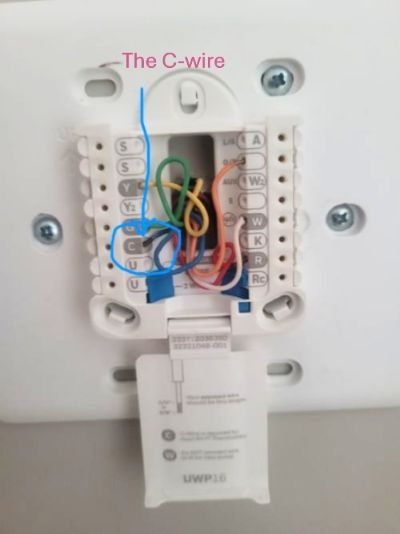
Thermostat base showing a C-wire
The other catch, high-efficiency "communicating" systems
Here's one thing that won’t be on the box warning you. Many of today's top-tier systems the high-efficiency, variable-speed heat pumps and furnaces, talk to their own matched thermostat over a proprietary "communicating" connection. On those, you often can't just drop in an off-the-shelf smart thermostat. A generic one will either refuse to run the system, or it'll force that expensive variable-speed equipment to limp along like a plain single-speed unit throwing away the efficiency and comfort you paid a premium for.
How to tell if your system is a recent high-efficiency or variable-speed model and the thermostat that came with it is a matched branded unit often wired with just a couple of communicating wires instead of the usual bundle assuming it's a communicating system. Check the equipment manual or ask your installer before you buy anything. On this kind of system, the branded thermostat isn't an upsell; it's required to make the equipment do what it's built to do.
What does a communicating thermostat do? It gives you and the technician error codes that can help diagnose your problems easier. If it is on the internet your contractor maybe able to see what is wrong and bring the part with him, for speedier repair.
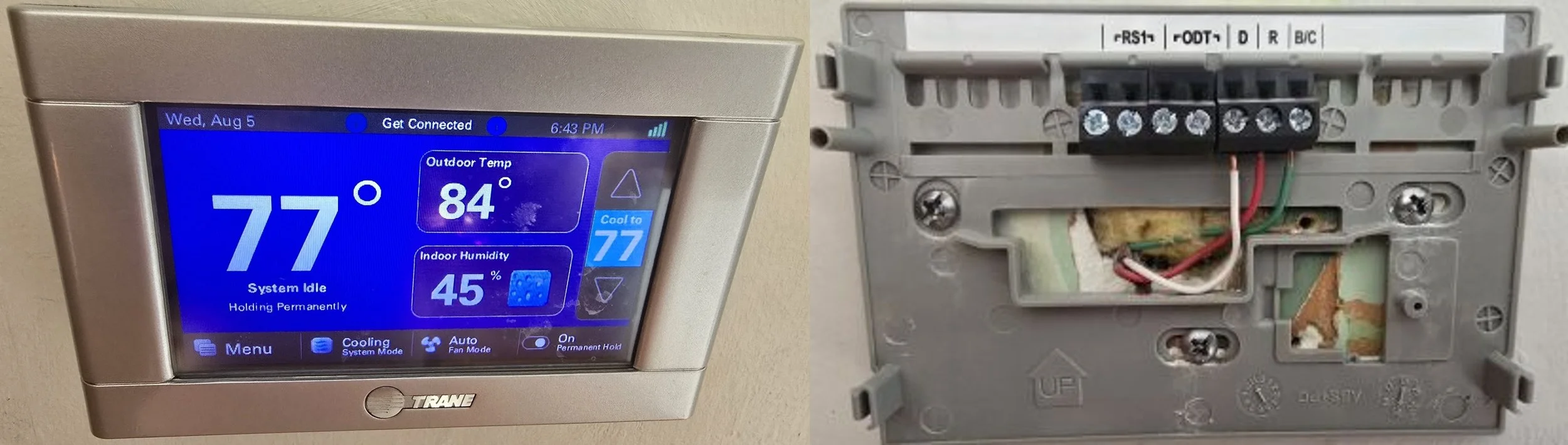
A Trane communicating thermostat beside it base showing only 3 wires
Careful with the "free" thermostat in a bundle
This is where the two catches above really matter. Solar companies, security and alarm companies, and energy providers love to toss a "free" smart thermostat into their package to sweeten the deal. It sounds like a nice perk and sometimes it is. But that thermostat is almost always a generic Wi-Fi model the salesperson likes for their own app, and whether it'll even work on your system is a question they often can't answer at your kitchen table.
Two ways that "free" thermostat turns into a headache:
• You have a communicating high-efficiency system. As we covered, a variable-speed heat pump or furnace usually needs its own matched control. Their generic thermostat likely can't be installed at all and if it somehow is, it'll dumbs down your expensive equipment down to single speed. In that case the right answer is simple: keep your matched thermostat and politely turn down the freebie.
• You don't have a C-wire. Their installer may not want to run one, and a rushed workaround can leave you with a thermostat that drops offline or won't hold power. That's their five-minute problem becoming your all-summer problem.
If you do use one of these thermostats, insist they leave your orginal thermostat. This is encase you need to have it re-installed.
There's one more thing worth thinking about: a bundled thermostat is sometimes tied into that company's app and account. Cancel the service down the road and you may lose features or be left with a device you don't fully control.
None of these means say no automatically. It means ask one question before you accept it: "Will this specific thermostat work with my exact heating and cooling system?" If you've got variable-speed or communicating equipment, or no C-wire, make them prove the answer is yes in writing if you can. A free thermostat that hobbles a system you paid thousands for isn't free at all.
So, which should you get?
• Get a smart thermostat if your schedule is unpredictable, you like seeing your usage, you've got a heat pump or a multi-zone system, or you just know you won't fuss with a schedule. This is most people.
• Get a programmable if you keep a steady routine, you're on a budget, and you'll genuinely set it and leave it.
• Stick with a simple manual if the house is occupied around the clock (so there's no empty-house setback to capture), someone's uncomfortable with technology, or it's a rental or second home where simple is better.
One setting that beats any upgrade
Before you spend a dime, know this. The single biggest savings isn't the thermostat, it's the setback. Nudging the temperature 7 to 10 degrees in the direction of the weather for the 8 hours you're asleep or away is where the real money is. A $250+ smart thermostat that you keep pinned at one temperature all day will save you exactly nothing. A $30 dial you bump before bed will save you real money. The habit matters more than the hardware.
And while we're at it set the fan to AUTO, not ON. On ON, the blower runs nonstop and pushes room-temperature air between cycles, which costs you money and makes the house feel less comfortable, not more.
A quick word on installing it yourself
Swapping a thermostat is one of the more DIY-friendly jobs in the house but respect the wiring. Kill the power to the HVAC at the breaker first (low voltage won't hurt you, but a short can fry a control board, fuse or transformer). Take a photo of the old wiring before you disconnect anything (I do this in the field all the time) and label the wires with the little stickers that come in the box. If you've got a heat pump, dual fuel, or anything with more than the usual handful of wires, that's a good moment to call a pro rather than guess.
One thing worth knowing as a customer, if an HVAC company tells you a new system "requires" their pricey proprietary thermostat, ask whether it's a true communicating system (see above) or just an upsell. On a standard system, a quality off-the-shelf thermostat runs it just fine, and that's the one part you can easily buy and install yourself. On a genuine communicating system, though, the matched control really is required — so it's worth knowing which camp your equipment is in before you assume either way.