Is your ac frozen?
Is Your AC Frozen? The Quick Way to Tell — Even If You Can't See the Coil
Short answer: On a hot day, walk out to your outdoor unit and look at the copper lines where they connect to it. If you see frost or ice on them, your system is frozen up — and the ice hidden inside on the indoor coil is far worse than the little bit you can see outside.
Signs your system may be frozen up
You usually feel a frozen system before you ever see the ice. Any one of these is worth a look outside:
The house won't cool. The AC runs and runs, but the temperature never comes down and the thermostat keeps falling behind.
Little or no air from the vents. Most of the time you feel almost nothing coming out — the ice has choked off the airflow.
Frost or ice you can see. On the copper line at the outdoor unit (the tell below), or on the indoor unit itself if it's somewhere you can spot it.
Water around the indoor unit, furnace, or air handler. That's melted ice overflowing the drain pan — often the first clue for a coil you can't see.
The system never shuts off and your energy bill climbs — a frozen system runs nonstop trying to reach a temperature it can't hit.
Here's the trap most homeowners fall into. The part that freezes — the indoor evaporator coil — is usually tucked in an attic, a crawlspace, or a closet you never open in the middle of summer. You have no reason to look there and no easy way to see it. So the freeze goes unnoticed until the house just stops cooling and you're standing in front of the thermostat wondering what happened.
The shortcut is the outdoor unit. When the indoor coil ices over, that frost backs up the large insulated refrigerant line all the way out to the condenser outside — and that you can see without crawling anywhere.
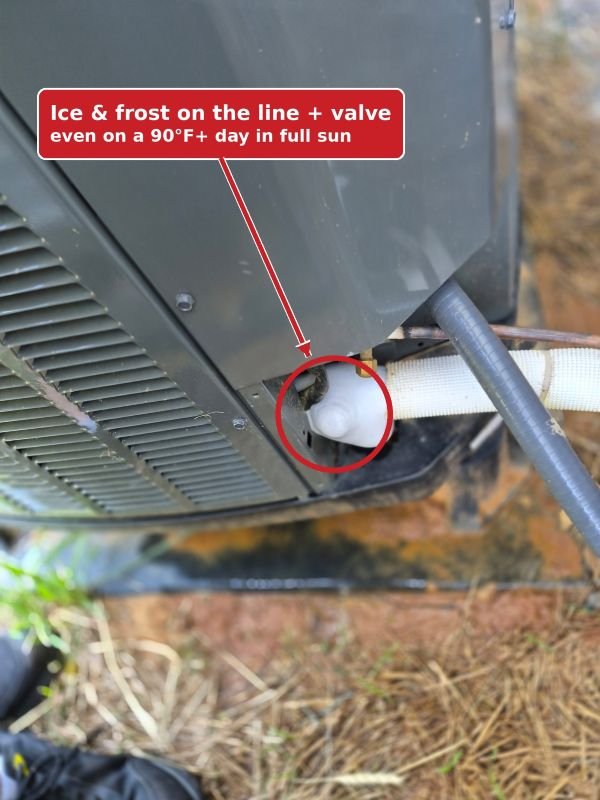
Ice and frost on the line and valve even on a plus 90°F day in full sun.
If you spot frost on that line on a 90-degree day, take it to the bank: the indoor coil is packed with ice — easily an inch thick on either side.
Why a coil freezes
It almost always comes down to one of two things:
Restricted airflow — the common one. It usually starts at the filter: clogged, the wrong type, or missing altogether. But here's what most people miss — when the blower can't pull enough air, it grabs it wherever it can, including around the edges of the filter. That unfiltered air carries dust straight onto the evaporator coil, and over time the coil itself cakes over. A dirt-packed coil chokes its own airflow and freezes — and once that happens, a fresh filter alone won't fix it; the coil has to be cleaned. (Closed or blocked vents and a weak blower do the same thing.)
Low refrigerant — almost always a leak. Less refrigerant means lower pressure and a colder coil that frosts over.
Other issues are possible too, but only a trained professional can pin those down.
The simplest prevention in this whole article: keep a good filter in, change it on schedule, and never run the system without one.
What to do right now
Turn the cooling off. Running a frozen system can pull liquid refrigerant back into the compressor and damage it — one of the most expensive repairs there is. Set the system to OFF.
Run just the fan. Set the thermostat fan mode to ON to help the ice thaw faster. A full thaw can take a few hours to 12 hours — don't rush it.
Check the filter. If it's dirty, replace it. This is the single most common cause, and the easiest fix.
Open your vents and returns. Make sure furniture, rugs, or closed registers aren't choking the airflow.
Restart and watch. Once it's fully thawed and the filter's fresh, turn cooling back on and keep an eye on it.
When to call a pro
If it freezes again after a clean filter and open vents, stop there — that points to low refrigerant, a weak blower, or an evaporator coil caked with dirt that needs professional cleaning. Refrigerant is sealed and federally regulated; it is not a DIY top-off.
When you notice the system is freezing or frozen, set the system mode (off, heat, cool) to OFF and the fan mode to ON. Even if you start feeling air coming out of the ducts, DO NOT turn the system back to cool. If a technician comes out and sees a frozen system, he'll have to return another day to diagnose it — and you still pay the diagnostic fee.
One thing worth knowing as a customer. If a tech just adds refrigerant and drives away, they've treated the symptom, not the cause. Refrigerant doesn't get "used up" — if it's low, you have a leak. Ask them to find it. The same holds true for airflow. Make them do a proper assessment of your system.