Filters
How Often Should You Change Your Furnace Filter? (And Why a $6 Part Saves You Thousands)
Short answer: Check it monthly and change it every one to three months. A basic pleated filter costs about $5 to $15. Skipping it is one of the most expensive mistakes a homeowner can make — it leads straight to a frozen coil, a repair bill, and sometimes a four-figure coil replacement.
Your air filter is the cheapest part in your entire HVAC system, and the most neglected. Its job is simple: keep dust out of the equipment so the system stays healthy, and out of the air you breathe. Let it go, and that little cardboard frame quietly turns into a very expensive problem.
What a neglected filter actually does
Here's the chain that plays out behind the scenes. Left too long, the filter mats over solid:
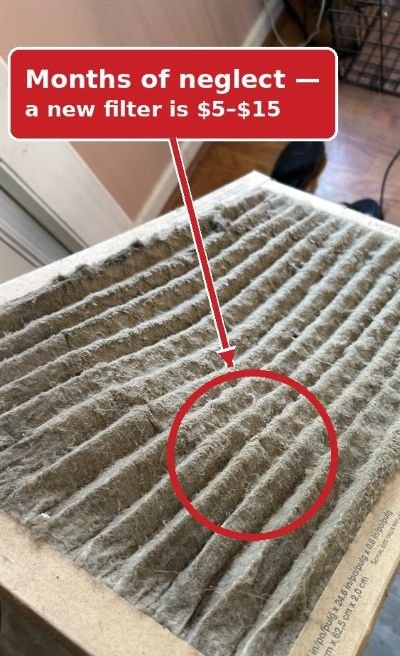
A pleated filter matted shut — months past due.
A clogged filter starves the blower. Starved for air, the blower pulls it from wherever it can — including around the edges of the filter. That unfiltered air carries dust straight onto the evaporator coil, and over time the coil itself cakes over:
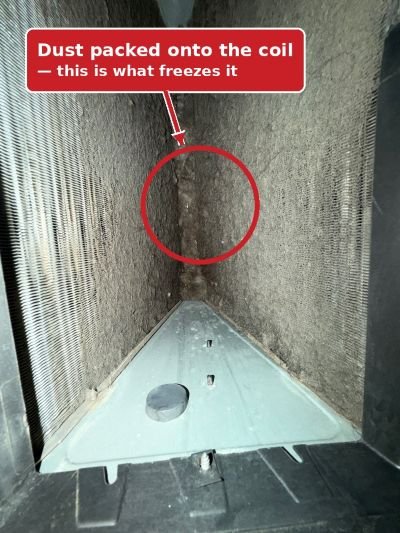
This coil is the next filtering point in a heat pump. With no filter or a filthy one left too long. This is where the dirt ends up.
A dust-packed coil can't move air, gets too cold, and freezes solid. Once it's caked like this, a fresh filter alone won't fix it — now you're paying for a tech to come out.
In a heat pump, the blower wheel is the next place dirt collects:
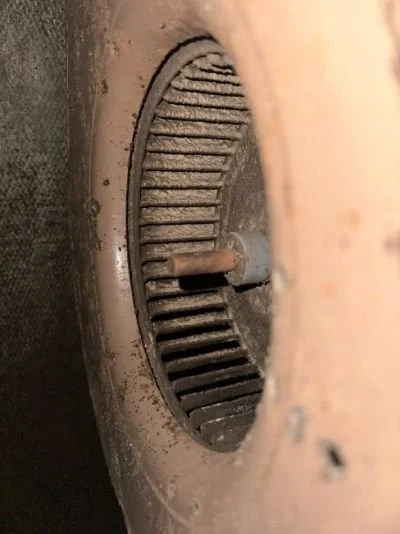
A blower wheel packed with dirt moves less air and works harder on every cycle.
Math that should change your habit
This is the whole argument in a few numbers:
A new filter: about $5 to $15 — often around $5 each in a multipack.
Just having a tech look: a diagnostic / service call runs about $75 to $200.
Cleaning a coil that's already caked: a professional coil cleaning runs about $150 to $700 — and one packed like the photo lands at the high end, often $300 and up once it has to be deep-cleaned or pulled out.
Replacing the coil it ruined: an evaporator coil replacement averages roughly $2,450, commonly $1,900 to $3,000 — more once it's out of warranty.
If your coil lives in an attic or crawlspace: add about $150 to $450 for the hard access — and that's exactly where these hidden coils tend to be.
A dirty blower: it moves less air, which means higher energy bills and a shorter life for the blower motor.
Cleaning the blower: ranges from $150 to $600.
Replacing the blower motor: ranges from $600 to $1,400 or more.
So you're weighing a few dollars for a filter against a bill that climbs from hundreds into over a thousand the longer you wait. There isn't a better return on five bucks anywhere in your house.
And that's before your power bill
The repair bill is the disaster scenario. But a clogged filter is quietly costing you every month it's left in. The U.S. Department of Energy says swapping a dirty, clogged filter for a clean one can lower your heating and cooling energy use by 5 to 15 percent — a starved system simply runs longer and harder to move the same air.
Put a number on it: say you spend around $150 a month cooling your home in summer. A 5% bite is roughly $7.50 a month — so a $5 to $15 filter pays for itself in its first couple of weeks and keeps paying every month after. (Illustrative; your bill and savings will vary.)
And here's the kicker: the DOE makes the very same point about the coil. When air sneaks around a clogged filter, it carries dirt straight onto the evaporator coil and chokes its ability to absorb heat. Cheap part, expensive consequences.
One important exception: if your health calls for a higher-MERV filter — allergies, asthma, or someone immune-compromised at home — use it without hesitation. A denser filter gives back a little of that energy savings and loads up faster, so check it at least once a month. But don't think twice about the trade-off — your health is worth far more than the few dollars a cheaper filter saves you.
How to do it right
What does MERV mean?
MERV stands for Minimum Efficiency Reporting Value — the industry standard (set by ASHRAE) for how much a filter actually catches. It runs from 1 to 16 for home filters: the higher the number, the smaller the particles it traps — but the harder your system has to work to pull air through it. That's the trade-off in a nutshell.
MERV 1–4 (basic flat fiberglass): only the big stuff — pollen, dust, lint, and carpet fibers. It protects the equipment more than it cleans your air.
MERV 8 (my pick for most homes): catches the everyday allergens — pollen, dust, mold spores, and pet dander — while still letting the system breathe.
MERV 11–13: finer particles — fine pet dander, smoke, smog, and some bacteria. A good step up if someone in the home has allergies or asthma.
MERV 14–16: the finest — most bacteria, virus-carrying droplets, and the smallest smoke particles. Excellent filtration, but dense enough that many home systems can't push air through it without straining. Never go higher than your equipment is rated for — check the manufacturer's spec first.
Check monthly, change every 1–3 months. Sooner if you have pets, heavy dust, or allergies.
A cheap pleated filter is the sweet spot. For most homes a basic pleated MERV 8 filter is ideal — high enough to protect the system and clean your air, not so dense it chokes airflow. Skip the flat fiberglass kind: my rule is if you can see through it, dust can get through it. A pleated filter catches what fiberglass lets sail right past. And higher isn't automatically better — match the manufacturer's spec.
Get the right size so it fits snug. Gaps around the frame are the bypass that dirties your coil anyway. Check the airflow arrow on the edge and point it toward the blower. Heads up: the big-box stores may not carry your exact size — only one slightly shorter or wider, and often only in the pricier hypoallergenic filters you may not need. The easiest fix is to order the exact size online.
Never run the system without one. "Just for now" is how the coil in that photo got there.
Write the date on every filter. That way you always know when it was last changed.
Don't get played by "up to 3 months"
Filter boxes love to print "3 MONTHS" big and bold. Look closer and you'll usually find a tiny "up to" in front of it. That's a best-case maximum, not a schedule — pets, heavy dust, allergies, or a hard-running summer or cold winter can clog a filter in three or four weeks. Check it monthly and let your eyes decide, not the box.
When a filter won't be enough
If the coil is already caked, or the system freezes again after a fresh filter and you've confirmed the supply and return vents are open, it's time to call a professional. It could be a clogged coil or another issue. Still far cheaper than the replacement you're trying to avoid — but past the point a new filter can fix.